How to Break the Sedentary Coding Habit (Without Losing Flow)
A practical system for adding movement to a developer's workday: walk breaks, standing blocks, and movement snacks, based on what stuck after a year of trying.
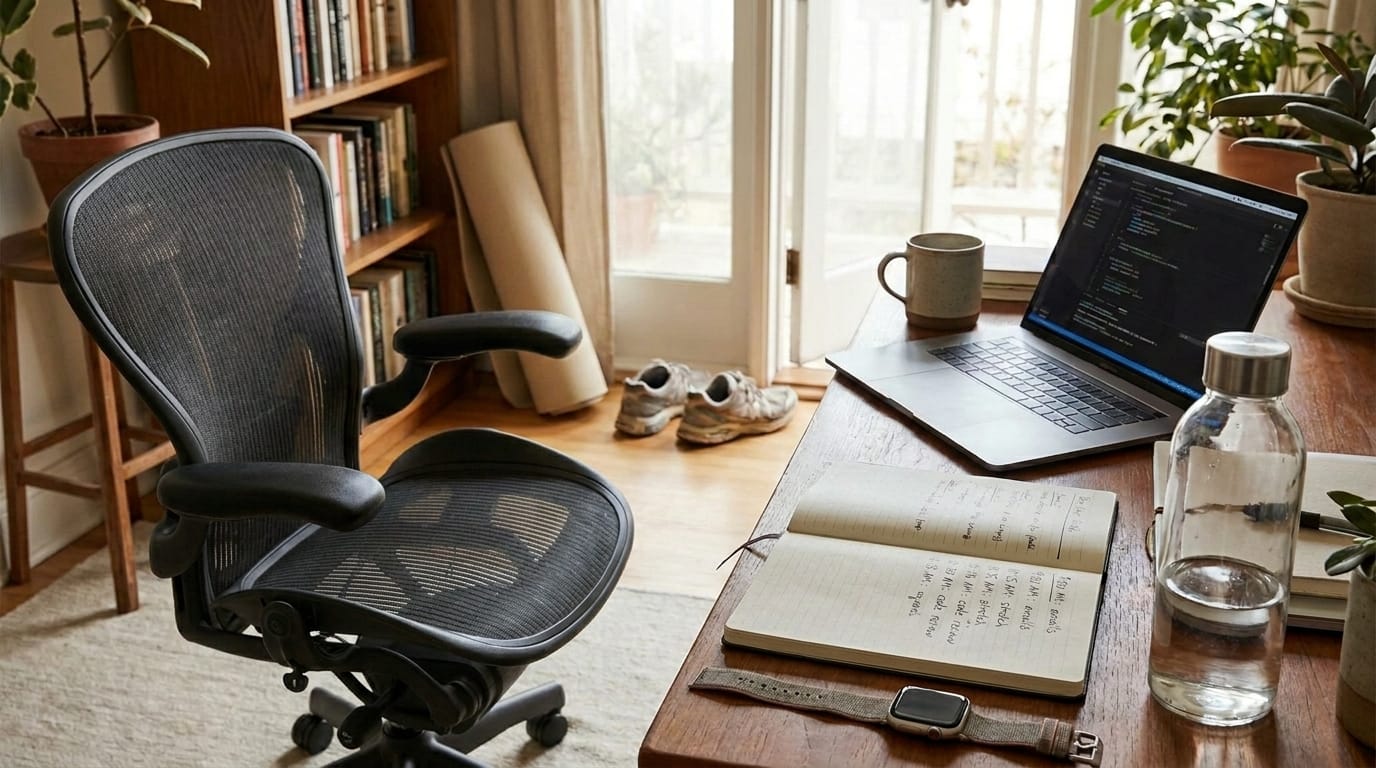
I wore an Apple Watch for two weeks last year and tracked everything: steps, standing hours, active minutes. The numbers were bad. On a typical coding day I sat for 11.5 hours, took fewer than 2,000 steps, and stood up maybe four times outside of bathroom breaks. One Thursday I logged 843 steps total. That’s less than half a mile. I’d walked more in a single trip to the grocery store than in an entire workday.
The weird part? I felt fine. My back didn’t hurt (yet). I wasn’t out of breath climbing stairs (yet). I was 31 and my body was quietly absorbing the damage without complaint. It took seeing the actual data (a two-week average of 1,800 steps per day on workdays versus 8,200 on weekends) to understand how sedentary remote development work really is.
This article is what I changed after that wake-up call, what stuck after a year, and what didn’t work despite sounding good on paper.
What prolonged sitting actually does (the specific research)
I’m not going to wave vaguely at “studies show sitting is bad.” Here’s what the research actually says:
A 2024 meta-analysis in the British Journal of Sports Medicine by Ekelund et al. found that sitting for more than 8 hours per day without physical activity was associated with a risk of premature death comparable to smoking and obesity. But here’s the part most articles leave out: 30–40 minutes of moderate-intensity activity per day largely offsets that risk. You don’t need to become a CrossFit person. You need to not be completely stationary.
On the cognitive side, a 2023 study from the University of British Columbia (published in JAMA Network Open) showed that after 90 minutes of continuous sitting, working memory performance dropped by 10–15% compared to participants who took short walking breaks every 30 minutes. Working memory is what holds the problem in your head while you code: the call stack, the data flow, the edge case you’re trying to reason about. A 10% drop in that capacity means more bugs, more time re-reading code you just read, and more “wait, what was I doing?” moments.
The connection to code quality isn’t metaphorical. When your working memory degrades, you reach for simpler solutions. You copy-paste instead of abstracting. You add another if-statement instead of rethinking the data model. I noticed this pattern in my own commits. My afternoon code, after 4+ hours of unbroken sitting, had measurably more lint warnings and required more review rounds than my morning code.
The three strategies that actually stuck
I tried a lot of things. Walking meetings, desk yoga, a balance board, the 25-minute Pomodoro with movement (too short for coding), an app that locked my screen every 30 minutes (infuriating). Here are the three that survived more than a month.
Movement triggers tied to your dev workflow
The idea is simple: attach a physical action to something you already do at your computer. Not on a timer — on a trigger that’s part of how you work.
- After every git pushStand, walk to the kitchen, refill water
- During a CI / build waitCalf raises and shoulder rolls
- After closing a PR review30 seconds of stretching
A push means a chunk of work is done. It’s a natural pause point, not an interruption. I push maybe 4–6 times on a productive day, which means 4–6 short walks without thinking about it. The build wait is dead time anyway, now it’s mobility time. The PR-review stretch took the longest to become automatic, but it’s the one that fixed my neck pain.
Timer-driven breaks
- Goes off mid-flow
- Resented and snoozed within a week
- 23 min refocus cost when it interrupts deep work
- Feels like an interruption
Event-driven triggers
- Fires between flow states, never inside them
- Tied to actions you already perform
- Zero refocus cost — there was nothing to refocus on
- Feels like the rhythm of your day
The key insight is that these triggers work because they’re event-driven, not time-driven. A timer interrupts flow. A git push happens between flow states. That distinction matters enormously. I’ve written about protecting flow states in my deep work article. Movement habits need to work with your focus patterns, not against them.
You don’t need to copy my exact triggers. Look at your own workflow and find the natural seams, the moments where you’re already context-switching. Those are your movement windows.
The standing desk reality
I bought a FlexiSpot E7 standing desk about 14 months ago. Here’s the honest review you won’t get from someone who just unboxed theirs.
What’s genuinely good: It forces position changes. Even if I don’t stand for long stretches, the act of raising and lowering the desk several times a day means I’m shifting my posture, adjusting my weight, engaging different muscle groups. My lower back pain, which had become a near-daily thing by month 8 of remote work, is mostly gone.
What’s overhyped: Standing all day is not the answer. Standing for 4 hours straight is its own kind of miserable: sore feet, aching knees, and a weird fatigue that’s different from sitting fatigue but just as real. The research supports this: a 2023 Cochrane review found that sit-stand desks reduce sitting time by 30 minutes to 2 hours per day, but there’s limited evidence they reduce musculoskeletal symptoms on their own. The benefit comes from alternating, not from standing.
What nobody mentions: You need an anti-fatigue mat (I use a basic one from Amazon, ~$35), and your monitor setup gets complicated. A laptop on a standing desk means you’re looking down, which defeats the purpose. I ended up needing a monitor arm and an external keyboard, which added another $150 to what was already a $500 desk. Budget for the full setup, not just the desk.
My actual pattern: I stand for 20–30 minutes, sit for 60–90 minutes, repeat. The desk has memory presets, so switching takes 3 seconds. I don’t follow a strict schedule. I stand when I notice I’m getting restless or when I hit a natural break point.
If you can’t afford a standing desk (and $500+ is a lot), a $30 laptop riser and a wireless keyboard gets you 80% of the benefit. You won’t be able to alternate as smoothly, but you’ll be shifting positions, which is the part that matters.
The end-of-day physical reset
This is the one that had the biggest impact on my overall well-being, and it’s also the simplest: a 20–30 minute walk at the end of the workday, every workday, no exceptions.
When you work remotely, there’s no commute to signal the transition from “work brain” to “personal brain.” I used to just close my laptop and… sit on the couch. Same posture, same room, different screen. The walk replaces the commute. It’s a physical ritual that tells your body and brain: work is done.
I’m not prescriptive about what this looks like. Some days I walk around my neighborhood. Some days I do a short bodyweight routine (push-ups, squats, lunges — 15 minutes, no equipment). On weekends I ride my bike. The only rule is: it happens between closing my laptop and starting my evening, and it involves leaving my desk.
The compounding effect surprised me. After about three weeks of consistent end-of-day walks, I started falling asleep faster, waking up less groggy, and, unexpectedly, making fewer errors in my morning deep work block. The research on this is clear: a 2022 study in Psychology of Sport and Exercise found that even a 10-minute walk improved executive function and mood for up to 2 hours afterward. A 20-minute walk at 5pm means you’re carrying that benefit into your evening.
The flow state objection
“I can’t take breaks — I’ll lose my flow.” I’ve said this. I believed it. It’s partly true and partly a rationalization.
Here’s the nuance: not all breaks are equal, and not all flow is worth protecting.
There are two situations:
Deep flow on a hard problem: you’re 40 minutes into debugging a race condition, you’ve finally built the mental model of what’s happening, and you’re about to test your theory. A timer goes off telling you to stretch. You ignore it. That’s the right call. Breaking this kind of flow is genuinely costly. It can take 15–25 minutes to rebuild the mental context (Gloria Mark’s research at UC Irvine puts the average at 23 minutes after an interruption).
Pseudo-flow on routine work: you’ve been writing CRUD endpoints for 2 hours, you’re in a rhythm but not solving anything hard, and you haven’t stood up because you’re “in the zone.” This isn’t deep flow. This is inertia. Breaking it costs you nothing, and the movement break will actually improve your focus when you return.
The trick is learning to tell the difference. For me, the test is: “If I take a 2-minute break right now, will I struggle to pick up where I left off?” If the answer is no, if I could explain to a coworker exactly where I am and what’s next, then it’s safe to break. If the answer is “I’ll lose the whole mental model,” then I keep going and take a longer break when I reach a save point.
This is why event-driven movement triggers work better than timers. A git push is a natural save point. Build completion is a natural pause. They happen at moments when the mental cost of a break is low.
Tracking movement
If you’re using a habit tracker, add one movement-related item. Not five. One.
I track “20min walk,” a single binary checkbox. Did I take my end-of-day walk? Yes or no. I don’t track steps, standing minutes, or how many times I stretched during builds. Tracking too many things turns movement into a chore and makes you feel like you’re failing on the days you only did 3 out of 5 items.
One checkbox, one habit. When that becomes automatic (and it took me about 6 weeks), you can add another. My second addition was “morning stretch (5 min)” which I added three months after the walk was already locked in.
The pattern matches what I’ve seen work for building a habit journal: track the minimum viable version of the behavior until it stops requiring willpower, then expand.
Common mistakes that kill movement habits for developers
Going too big on day one. “I’ll do 50 push-ups every hour” lasts two days. “I’ll stand up when I push code” lasts a year. Start with something so easy you feel silly tracking it.
Using timers that interrupt flow. If your movement reminder makes you resent moving, it’s counterproductive. Tie movement to workflow events, not arbitrary intervals.
Buying equipment before building the habit. A standing desk won’t make you stand. A yoga mat won’t make you stretch. Build the behavior first with zero-equipment movement (walking, bodyweight exercises), then add tools to support a habit that already exists.
All-or-nothing thinking. “I didn’t walk today so the whole week is ruined.” No. You missed one day. The data on habit formation shows that missing a single day has essentially no effect on long-term habit strength. Missing two or more consecutive days is where streaks break. So if you skip today, do it tomorrow. That’s all that matters.
Treating weekends as compensation. “I’ll just go to the gym on Saturday to make up for sitting all week.” That’s not how your body works. Five days of 11-hour sitting followed by a 90-minute gym session isn’t balance. It’s damage plus a band-aid. The daily minimum, even just a 20-minute walk, matters more than a weekend workout.
FAQ
How much movement do I actually need to offset a full day of coding? The research converges on about 30–40 minutes of moderate activity per day (walking counts). The WHO’s 2020 guidelines, updated to address sedentary behavior specifically, recommend 150–300 minutes per week of moderate activity. That’s 30–60 minutes on workdays. A 20-minute end-of-day walk plus a few movement breaks during the day gets you there without restructuring your life.
Do standing desks actually help, or are they just a trend? They help, but not for the reason most people think. Standing itself isn’t significantly better than sitting. The benefit comes from changing positions throughout the day. A sit-stand desk makes that switching frictionless. If budget is a concern, a laptop riser you can add and remove achieves a similar effect for a fraction of the cost. The research (2023 Cochrane review) shows the gains are real but modest.
What if I work in an open office and can’t just walk around randomly? Fair concern. Use seated alternatives for your between-task movement: ankle circles, seated spinal twists, shoulder rolls, things that look like “stretching at your desk” rather than “weird exercises in the middle of the office.” Save the walking for lunch and end-of-day. And if you have any say over your schedule, try to cluster meetings so you can walk between them instead of sitting through back-to-back video calls at the same desk.
I already exercise in the morning. Do I still need to worry about sitting all day? Yes. This is the “active couch potato” problem, a term from a 2020 study in the British Journal of Sports Medicine. People who exercise for 30–60 minutes but sit for 10+ hours the rest of the day still show elevated health risks compared to people who exercise and break up their sitting throughout the day. Your morning run is great. It doesn’t cancel out 8 hours of immobility afterward. You still need the small breaks.
Won’t my manager think I’m slacking if I take walking breaks? If you’re remote, nobody sees you walk to the kitchen. If you’re in an office, taking a 2-minute stretch between tasks is normal behavior, and the concern is usually in your head. The more real version of this worry is about response time: “what if someone Slacks me while I’m walking?” A 5-minute delay in responding to a Slack message has never caused a production outage. If your team culture genuinely penalizes a 5-minute gap, that’s a culture problem worth naming, not a reason to sit for 11 hours.
Start tomorrow
Don’t try to overhaul everything at once. Pick one thing:
Take a 20-minute walk after you close your laptop tomorrow. That’s it. No standing desk, no stretching protocol, no app. Just a walk, at the end of the day, before you sit on the couch.
Do it for a week. See how you feel on Friday compared to this Friday. If it makes a difference — and for most people, it will — then you have your foundation. Build from there.
Get the Developer Habit Toolkit.
A free Notion template, 30-day challenge, and habit stacking guide — built for devs. Enter your email and we'll send it over.
No spam, unsubscribe anytime.