How Developers Actually Build Habits That Stick
Developers optimize systems for a living, then wing their habits on willpower. Here's the system that makes them stick: habit stacking, streaks, low friction.
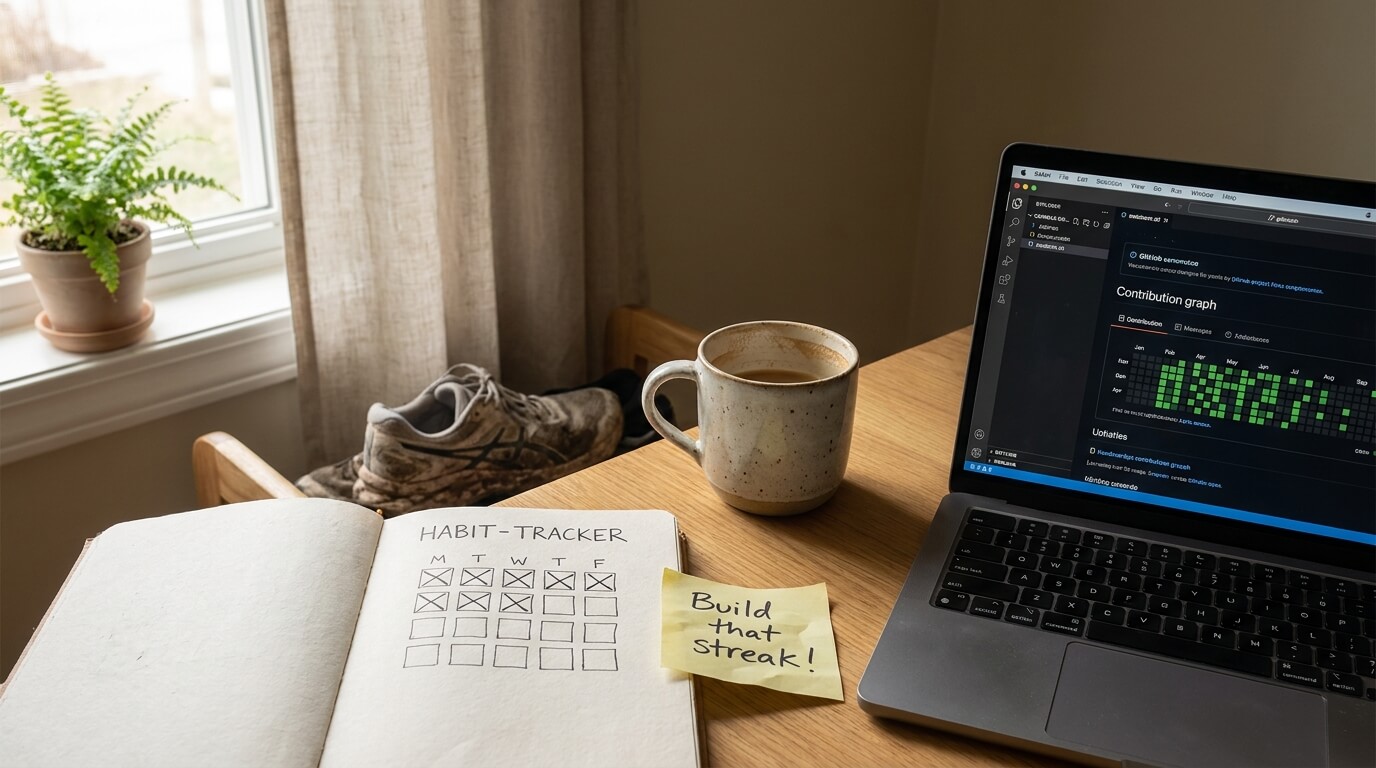
Here’s something I find genuinely funny about developers, myself included: we will spend a full afternoon setting up a CI pipeline so a task never has to be done manually again, then try to build a personal habit by just… remembering to do it. We automate everything at work and run our own lives on raw willpower. Then we’re surprised when the gym habit dies in week two.
This is the post I wish someone had sent me years ago. There’s no motivation talk in it, just the same systems-thinking you already apply to code, pointed at your own habits.
Why developers are uniquely bad at their own habits
It’s not a character flaw. It’s a misapplied skill.
At work, you don’t trust your memory. You write the test, set up the lint rule, schedule the cron job. You build systems precisely because you know that humans, yourself included, are unreliable executors. The whole discipline is “make the right thing automatic and the wrong thing hard.”
Then you go to build a personal habit and throw all of that out the window. “I’ll meditate every morning.” How? Triggered by what? Tracked how? Recovered how when you miss a day? There’s no system. It’s a wish with a start date. And a goal you merely wish for succeeds only about 4% of the time.
The fix isn’t more discipline. It’s treating your habits like you treat your codebase: design the system, reduce the friction, watch the metric.
First, kill two myths
Myth 1: It takes 21 days. It doesn’t. A 2024 meta-analysis on habit formation (Singh et al.) puts the median at 59 to 66 days, with individual times ranging from a few days to nearly a year depending on the behavior and the person. If your new habit still feels like work at week three, you’re not failing. You’re just not at the median yet. I cover the full data in the habit statistics roundup. The short version: plan for two months, not three weeks.
Myth 2: It’s about willpower. Also no. Research finds that 66% of daily behavior runs automatically, triggered by cues rather than conscious decisions. Most of your day is already on autopilot. The opportunity is to get that autopilot pulling in your direction instead of against you, so willpower stops being the bottleneck.
The core technique: habit stacking
The single highest-leverage move is habit stacking: you anchor a new behavior to something you already do reliably. BJ Fogg’s Tiny Habits work and James Clear’s Atomic Habits land on the same mechanic: After [existing habit], I will [new habit].
This is where developers have an unfair advantage. Your workday is full of dependable triggers, events that already fire every single day, like a well-behaved event loop. You don’t need to invent a cue. You just subscribe to one.
- After I sit down and open my IDEI write one sentence: today's deep-work goal
- After I push my first commitI stand up and refill my water
- After daily standup endsI start a 50-minute focus block
- After I merge the last PR of the dayI log the habit and write tomorrow's first task
- After I close my laptopI put my phone on its charger in another room
Notice what these have in common: the cue is concrete and it already happens. “After I push my first commit” is unambiguous. You know exactly when it fires. Compare that to “I’ll take more breaks,” which has no trigger and so never happens.
Start with one stack. Not five. The fastest way to fail is to bolt a whole morning routine onto January 1st. Pick one anchor, attach one tiny habit, and let it go automatic before you add the next.
Why streaks and tracking actually work
Developers are rightly suspicious of gamification, and most of it is hollow. But the streak mechanic is the exception. It rests on one of the most robust findings in behavioral science.
A meta-analysis of 138 studies covering nearly 20,000 people found that monitoring your progress toward a goal has a real effect on actually reaching it (d = 0.40) — and that effect is strongest when you physically record it or report it to someone; there’s a full breakdown here. When you watch the number, the number tends to move. In one frequently-cited Dominican University study, people who sent weekly progress reports to a friend accomplished their goals, or got at least halfway, 76% of the time, versus 43% for those who only thought about them.
A streak pulls double duty. First, it makes the invisible visible: “Did I actually do my deep-work block most days this month?” becomes a glance instead of a guess. Second, it puts a small self-imposed cost on breaking the chain. Not a punishment, just enough friction in the wrong direction to tip a coin-flip day toward doing the thing.
The friction problem (and why “no signup” matters)
Here’s the part most habit advice skips: what kills tracking usually isn’t a lack of motivation. It’s friction in the tool itself.
If logging your habit means opening an app, signing in, waiting for a sync, and tapping through three screens, you’ve made the tracking harder than the habit. That’s backwards. It’s why so many beautiful habit apps get abandoned by week two: the overhead outweighs the payoff.
High-friction tracking
- Create an account, verify email
- Wait for cloud sync on every device
- Hunt through menus to log one thing
- Worry about who owns your data
- Quietly stop opening it after 10 days
Low-friction tracking
- Open it and it’s there, no login screen
- Data lives locally, loads instantly
- One tap to mark the day done
- Nothing to manage, nothing to leak
- Still using it in month three
This is exactly why Better Habits Daily is local-first and needs no signup: every account screen, every sync spinner, every settings menu is one more place where the habit of tracking the habit goes to die. The tool should get out of the way. The point is the streak, not the software.
That constraint is also why it ships with deep-work and no-social-media presets rather than hot yoga and gratitude journaling — the reasoning behind a habit tracker built for developers is a different set of defaults, not a different feature list. And if the XP and levels sound familiar, it’s deliberately a Habitica alternative without the RPG: the progress number without the avatars, gear, and party mechanics.
A starter developer habit stack
If you want a concrete place to begin, here’s what I’d hand a developer who’s never deliberately built a habit. Pick one of these, anchor it, and run it for two weeks before you add another.
- 01The focus blockAfter standup, start one protected deep-work block. The highest-leverage habit a developer can build.
- 02The movement triggerAfter your first push of the day, stand up and move for two minutes. Breaks the all-day chair.
- 03The screen curfewAfter you close the laptop, the phone charges in another room. Protects the sleep everything else depends on.
- 04The shutdown logAfter the last PR, log the day and write tomorrow's first task. Closes the loop and starts the streak.
Each of these has a full write-up if you want to go deeper: the deep work system, breaking the sedentary coding habit, and starting a habit journal for the shutdown log. If mornings are your weak point, the remote developer morning routine is the natural anchor for most of these.
How the people you admire actually do it
The developers and founders known for output almost never credit willpower. They credit systems. Naval Ravikant’s reading habit is a stack: he reads whatever he’s drawn to, every day, without forcing it. Andrew Huberman’s morning routine is a fixed sequence of anchored behaviors, not a daily negotiation. The pattern’s always the same: take out the decision, and the behavior takes care of itself.
You don’t need their discipline. You need their structure.
The honest parts
A few things I want to be straight about:
You will miss days. The system was never “don’t break the chain.” It’s “make a single miss cheap to recover from.” I’ve restarted my own streaks more times than I can count. The people who stick with it aren’t the ones who never slip. They’re the ones who slip once and show up again the next day.
Tracking is a little boring, and that’s fine. Most days it’s one tap, or a “did the block, ✓” in a notebook. The magic isn’t in any single entry. It’s in watching a month of green squares pile up and realizing the autopilot finally flipped to your side.
Not every habit needs to stick forever. Some you build for a season, a deadline crunch or a fitness goal, and then retire them. That’s not failure. A habit is a tool, not a vow.
Start one stack today
Don’t wait for Monday, and definitely don’t wait for January. The whole thing is four steps:
- Pick one habit from the starter stack above.
- Anchor it to a trigger you already do every day (
after I push my first commit...). - Make it small enough that it barely needs motivation.
- Track it with one tap and no signup, and don’t let one miss become two.
That’s the system. It’s the same instinct that makes you write the test instead of trusting yourself to remember: build the structure once, and stop relying on willpower you won’t have on a bad day. You already think this way about code. Point it at yourself.
FAQ
How long does it actually take to build a habit? Not 21 days. A 2024 meta-analysis puts the median at 59 to 66 days, with individual times ranging from a few days to nearly a year depending on the person and the behavior. Plan for at least two months before a new habit feels automatic, and don’t read a hard week three as failure. You’re just not at the median yet.
What’s the single most effective habit technique for developers? Habit stacking: anchoring a new behavior to a trigger you already do every day. “After I push code, I stand up and refill my water.” Your workday is already full of reliable cues (first commit, standup, last PR of the day). Bolt the new habit onto one of them instead of relying on remembering.
Do habit trackers actually work, or are they just productivity theater? They work. A meta-analysis of 138 studies found self-monitoring has a real effect on goal attainment (d = 0.40). The catch is friction: a tracker you have to sign up for, sync, and babysit gets abandoned by week two. The tracking has to be lower-effort than the habit itself.
Why do my New Year’s resolutions always fail by February? Because they’re motivation-based, and for most people motivation fades within the first couple of weeks of January (Strava’s data on mass fitness drop-off, “Quitter’s Day,” lands there every year). Resolutions also tend to be avoidance goals (“stop getting distracted”), which underperform approach goals (“do two hours of deep work before Slack”). Swap the framing and add tracking for accountability.
Should I build several habits at once or just one? One at a time, anchored and small. Stacking five new behaviors on January 1st is exactly the pattern that collapses. Get one habit automatic (give it a few weeks), then stack the next onto it. Slow is fast here.
Get the Developer Habit Toolkit.
A free Notion template, 30-day challenge, and habit stacking guide — built for devs. Enter your email and we'll send it over.
No spam, unsubscribe anytime.